
The sheer scale and potential of China's consumer market continue to draw overseas brands across baby care, beauty, home living, and many other sectors. Yet for all the ambition surrounding China entry, many brands still approach the market through the narrow lens of surface-level localisation. They adjust copy, adapt cultural references, and refine packaging, but overlook the deeper forces that actually shape brand growth in China: the country's distinct social platforms, its highly specific purchase decision dynamics, and the way marketing and conversion must be designed as one connected system. As McKinsey & Company often highlights in its China consumer reports, winning in this market requires a structurally different, localized operational model rather than just imported strategies. The result of ignoring this is familiar-traffic without traction, visibility without meaningful sales, and campaigns that generate attention but fail to win real consumer commitment.
As a Hong Kong-based agency with deep experience in both Chinese and international digital marketing, BINGO Digital has long focused on practical, execution-led strategies for overseas brands entering China. In our recent close analysis of the MONWILIK smart baby monitor campaign on Xiaohongshu, we found that the brand's success did not come from basic local adaptation. It came from something far more important: a sophisticated fit with Chinese user needs, platform behaviour, and the integrated logic of brand building and performance marketing. For overseas brands looking to enter China, the case offers a valuable lesson: the real opportunity lies not merely in localising for China, but in learning how to operate within China on China's terms.
Not just localisation, but local-market operations
MONWILIK operates in the smart baby monitoring category, a relatively blue-ocean segment within China's maternal and infant market. Category penetration remains low, and many consumers are still in the education stage. At the same time, a new generation of parents has already developed a strong demand for tools that make parenting more efficient, less stressful, and more manageable in daily life. Against that backdrop, MONWILIK did not take the conventional route of "adapting" an existing brand narrative for China. Instead, it started with the most immediate pain points of Chinese parents, chose Xiaohongshu as its core seeding platform, and used scenario-led content, a tiered influencer structure, and an integrated brand-performance model to achieve three things at once: capturing consumer mindshare, building category awareness, and driving e-commerce traffic to Tmall.
The outcome was more than impressive campaign visibility. MONWILIK successfully embedded the idea of "AI-powered parenting for mums who deserve breathing room" into consumer awareness, while also delivering a significant lift in branded and category keyword exposure on Xiaohongshu, strong growth in followers and engagement on the official account, and effective traffic redirection into e-commerce. What matters most, however, is how those results were achieved. This was not simply a matter of aligning with Chinese culture on the surface. MONWILIK built its entire system around the actual mechanics of marketing in China. That is precisely the mindset overseas brands need most.
Success in China begins when brands move beyond surface localisation and commit to local-market operations
From BINGO Digital's perspective, localisation should never be seen as the finish line for overseas brands entering China. It is only the starting point. Translation, cultural adaptation, and minor product adjustments are foundational, but they are not what unlock growth. The real breakthrough comes from understanding the operating logic of the market itself: what Chinese consumers genuinely care about, how Chinese platforms influence decision-making, and what kind of conversion path aligns with local behaviour. The MONWILIK case offers five highly practical lessons that overseas brands can apply.
Choose a core platform and go deep-do not spread blindly across every channel
China's platform ecosystem is highly segmented. Xiaohongshu, Douyin, Weibo, and WeChat each play very different roles, and simply showing up everywhere does not equal effective market entry. MONWILIK's first smart move was to identify Xiaohongshu as its primary seeding platform. The logic was straightforward. Xiaohongshu has an exceptionally strong concentration of maternal and infant audiences, with especially high relevance among urban women born in the 1990s and mid-1990s. These users do not make impulsive decisions. They research, compare, read reviews, and place heavy value on authentic shared experience. That behaviour aligned closely with MONWILIK's target audience.
But the brand did not treat Xiaohongshu as a content publishing channel alone. It built an integrated operating model around it-combining content accumulation, search optimisation, private traffic development, and paid media amplification. The official account continuously produced educational content and answered user questions. Influencer notes were structured around searchable keywords. Search ads were used to secure visibility around branded and category terms. Feed ads then amplified strong-performing content. In effect, Xiaohongshu became both a reservoir for brand credibility and an entry point into conversion.
For overseas brands, this is a crucial reminder. It is a mistake to transplant an overseas "multi-platform everywhere" model directly into China. It is an equally serious mistake to assume that broad platform coverage is itself a form of localisation. Each Chinese platform has its own consumer intent and its own role in the path to purchase. Xiaohongshu is especially powerful for research-driven recommendation and education. Douyin is stronger for entertainment-led conversion and fast-moving commerce. Weibo remains more relevant for broad awareness and momentum building. Brands should identify one or two core touchpoints based on their category and audience, then invest deeply rather than dilute resources across too many fronts. For baby care, beauty, and accessible luxury, Xiaohongshu often holds disproportionately high seeding value. For FMCG and mass-market categories, Douyin may offer greater conversion efficiency.
Translate product features into lived scenarios, not just selling points
One of the most common mistakes overseas brands make in China is to repeat the same product messaging that worked in their home markets. They lead with features, claims, or brand language that may sound credible internationally, but feel detached from Chinese consumers' daily reality. We have seen sunscreen brands try to import an "executive luxury outdoor lifestyle" angle that fails to resonate with Chinese office workers whose actual concern is commuting and day-to-day UV protection. We have also seen skincare brands use literal translations of technical claims that end up sounding stiff, unnatural, or irrelevant to local routines.
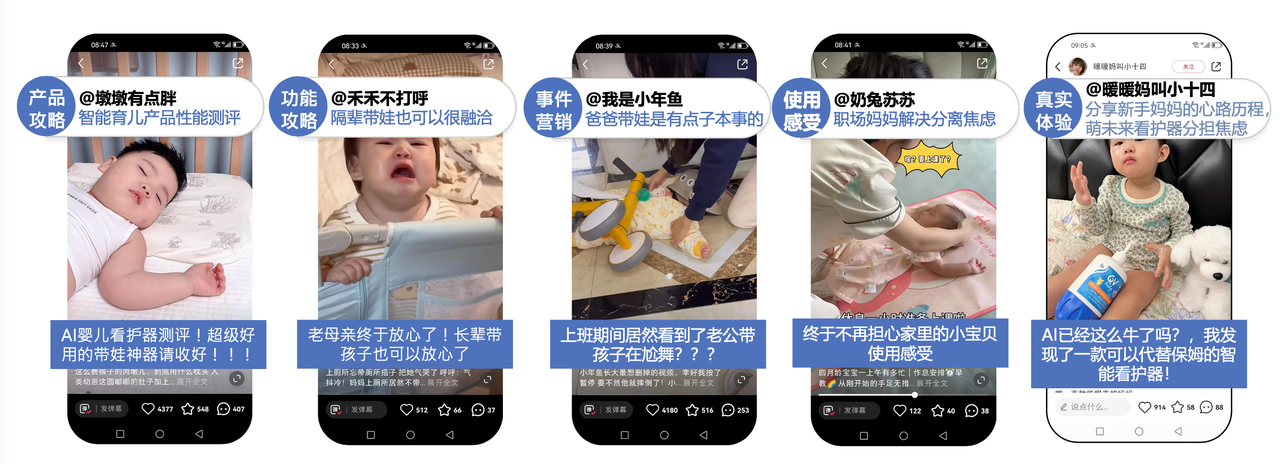
MONWILIK offers a much stronger model. Rather than overloading consumers with technical specifications, the brand translated product functionality into clear solutions for real parenting situations in China. Its product carried a wide range of features-AI virtual fencing, crying alerts, sleep tracking, temperature and humidity monitoring-but none of these were presented as cold technical assets in Xiaohongshu content. Instead, every function was anchored to real-life use cases that Chinese parents immediately recognised: being able to go to the bathroom while managing a baby alone, helping working mothers check in remotely, making it easier for grandparents to care for children, or reducing anxiety when a nanny is involved.
So "AI virtual fencing" was no longer an abstract tech phrase. It became a practical promise: if the baby crawls out of a safe zone, the parent is alerted immediately, so mum can cook or do laundry with greater peace of mind. "Crying alerts plus smart soothing" became something more emotionally legible: a new mother no longer has to remain on edge every second, because the system can respond quickly and give her a little room to rest. This is the power of leading with pain points and following with product features. It helps consumers feel, almost instantly, that the product is solving a problem they personally face. As Philip Kotler, the father of modern marketing, famously noted, "Marketing is the art of creating genuine customer value." In China's hyper-competitive landscape, this value must be immediately tangible.
For overseas brands, the implication is clear. Before entering China, invest in deep user scenario research. Find the intersection between what your product does and how Chinese consumers actually live. Chinese consumers do not buy products in the abstract. They buy the value those products unlock in their own lives. That is not simply a cultural preference-it is a core consumption logic.
Build trust through a layered influencer structure, not just top-tier visibility
China's social marketing environment has long moved beyond the era when a few top-tier influencers alone could guarantee results. In categories such as maternal care and beauty, where trust is central to conversion, authentic KOC content often carries more seeding power than polished celebrity-style sponsorships. This is a point many overseas brands still underestimate. After entering China, some brands focus almost exclusively on securing headline influencer partnerships, only to discover that their content looks overly commercial, disconnected from ordinary users, and ultimately weak in conversion.
MONWILIK's pyramid-style influencer matrix is especially instructive because it aligns with the way trust is actually built in the Chinese market.
- At the top were celebrity voices and the brand account, accounting for a small share of the overall mix. Their role was to provide authority and quickly elevate brand visibility. Importantly, the brand chose celebrities who were also mothers, such as Reyizha and Sun Yi, allowing the campaign to root product communication in recognisable parenting realities rather than generic endorsement.
- The middle layer consisted of maternal care and parenting KOLs, including childcare experts, fashionable mothers, and mothers raising twins. Their role was to deepen persuasion. They created richer, more informative content from different vantage points-professional childcare, everyday parenting routines, or the lived pressures of raising more than one child at a time. This middle tier strengthened both the practicality and the credibility of the brand.
- The bottom layer was made up of maternal KOCs, whose content created the broad sense of real, everyday recommendation. Their experiences-whether from ordinary mums, grandparents helping raise children, or working mothers balancing childcare with work-made the product feel socially validated and easier to trust.
What made this structure especially effective was not just the range of creators, but the discipline behind the content. MONWILIK ensured that all influencer materials were strongly tied to the product while remaining natural to each creator's voice. A childcare expert explained the product through the lens of infant safety. A mother of twins highlighted the value of support when energy and attention are stretched thin. There was no forced script and no obvious mismatch between messenger and message. That is central to China's social commerce environment: trust is built through believability, not broadcast-style promotion.
Connect seeding, traffic, retention, and conversion into one closed loop
Another major mistake overseas brands make in China is treating seeding and conversion as separate activities. They invest in content and paid traffic, but fail to build a conversion path that captures and carries user intent. That leads to a common outcome: the campaign drives attention, but not purchase. In China, the market has moved decisively into an era of brand-performance integration. Visibility and conversion are not competing priorities. They must be designed to reinforce one another.
MONWILIK's campaign is an excellent example of what a proper conversion loop looks like.
- At the seeding stage, the brand used influencer notes, official account content, and UGC participation to build a strong bank of persuasive material and stimulate category awareness.
- At the traffic stage, it combined broad-reaching feed ads with more targeted search advertising. Feed ads helped expose the brand to a wider pool of potential users, while search ads captured consumers already moving toward consideration. By maintaining strong positioning around branded and category keywords on a continuous basis, the campaign reduced the risk of losing interested users to competitors.
- At the retention stage, the brand's Xiaohongshu account functioned as a form of private-domain infrastructure. It responded to questions, built relationships, and ran community-style engagement activities that helped retain interested users rather than allowing them to drift away.
- At the conversion stage, Xiaohongshu traffic was directed into the Tmall flagship store, where promotions, social proof, and commerce-ready content took over and converted interest into purchase.
What matters here is not only the sequence, but the strategic consistency behind it. Every action served the same commercial objective. Keywords in content supported search conversion. Paid media supported qualified traffic acquisition. Community management supported long-term conversion. In a highly competitive China market, seeding that does not eventually lead somewhere is of limited value.
For overseas brands, the lesson is essential: before entering China, build a full-funnel system linking content, traffic, private-domain operations, and e-commerce. If users discover you on Xiaohongshu or Douyin, there must be a clear and coherent path into your storefront, whether that is Tmall, JD.com, Douyin Mall, or another appropriate channel. Just as importantly, all parts of the system must speak the same language. The keywords consumers encounter in seeding content should match what they search on e-commerce platforms. The promises made in influencer notes should align with the product page's value proposition. When those signals are fragmented, purchase intent weakens.
In blue-ocean categories, educate the market before trying to own the brand conversation
When overseas brands enter a relatively new category in China, they often rush straight into brand promotion. But if consumers do not yet fully understand the category itself, brand messaging alone will not be enough. In those cases, the first job is not to persuade users that your brand is better. It is to help them understand why the category matters at all.
MONWILIK's smart baby monitoring segment fits this pattern perfectly. Category penetration was still low, and many parents had not yet formed a clear view of what a smart monitor could actually do for them. Rather than assuming readiness, the brand invested first in category education. Through its official Xiaohongshu account and expert KOL content, it published materials that answered foundational questions: why a smart baby monitor is useful, what parenting problems it solves, and why it makes sense for modern families.
Only after creating that understanding did the brand move into brand occupation-embedding its own product advantages into the conversation so that users began to associate the category itself with MONWILIK. This "educate first, then seed" sequence allowed the brand not only to win mindshare, but to take on the role of category educator. That creates a powerful advantage, because when category growth accelerates, the brand is already positioned as the most natural choice.
For overseas brands entering emerging sectors in China, this is a critical strategic point. Do not skip the education phase. Use platform-native educational content and credible expert voices to explain why the category deserves attention in the first place. Once users understand what problem the category solves, they are far more ready to absorb brand differentiation-and far more likely to remember which brand guided them there first.
Entering China requires a change in thinking, not just a series of adjustments
China's market has already moved far beyond the stage where language translation and cultural adaptation are enough to create competitive advantage. Overseas brands that want to succeed must step outside the assumptions of their home markets and rebuild their approach around real Chinese consumer needs, China's platform-specific social ecosystem, and a fully integrated brand-to-conversion model. What is required is not a localised façade, but a genuinely local operating system.
That is exactly where BINGO Digital works. As a Hong Kong-rooted digital marketing agency connecting international and Chinese markets, we combine deep knowledge of Mainland China's digital landscape with a practical understanding of how overseas brands think, plan, and scale. From market research and user insight to platform strategy, influencer execution, and full-funnel conversion design, we help overseas brands build marketing systems that are truly fit for China.
Looking for a China full-service digital marketing partner you can trust?
BINGO Digital helps international brands build a compliant, full-funnel growth system across Xiaohongshu, Douyin, WeChat, and Baidu.
Contact BINGO Digital to get a China growth plan now!